Safety, Dignity, and Economic Security

Addressing the Intersection of Poverty and Violence Against Women in Rural Communities

Through funding received from Women and Gender Equality Canada, research conducted at HTH aims to restructure current understandings of economic insecurity, specifically, as it relates to the ongoing epidemic of gender-based violence against women and its close interconnection with poverty. The project is working to build a movement for the realization of a Basic Income Guarantee (BIG) within North Simcoe, through the establishment of a community network made up of municipalities, academic institutions, social services, regional committees, the local health unit, and women with lived experience of violence and poverty. 

The project engages women who have survived violence and poverty in feminist research to document their stories, strengthen social connections, and co-develop strategies for systemic change to support livelihoods and reduce gendered violence. By centering women’s lived realities, this project aims to dismantle internalized stigma, build solidarity, and empower women to shape policies and programs that meaningfully address the intersecting structures of gendered violence and economic marginalization. 

Our Process

Intersectionality

To understand how multiple systemic forces work together and interact to reinforce conditions of inequality and social exclusion

 Feminist, trauma-informed approach

To understand the sociopolitical context of women’s lives, the importance of sharing power in the research process, and to resist the reduction of experiences of gender-based violence to individual pathology 

The Design

Qualitative 

To enable depth, nuance, and meaning making, allowing women – as experts in their own lives - to articulate how structural conditions shape their safety, dignity, and economic security

Focus groups

To support collective meaning-making and facilitate peer connection

Thematic analysis 

Allowed for the identification of recurring patterns, meanings, and priorities across participants’ experiences, centering women’s voices and ensuring findings were grounded in lived realities

Our Major Insights

Thematic findings

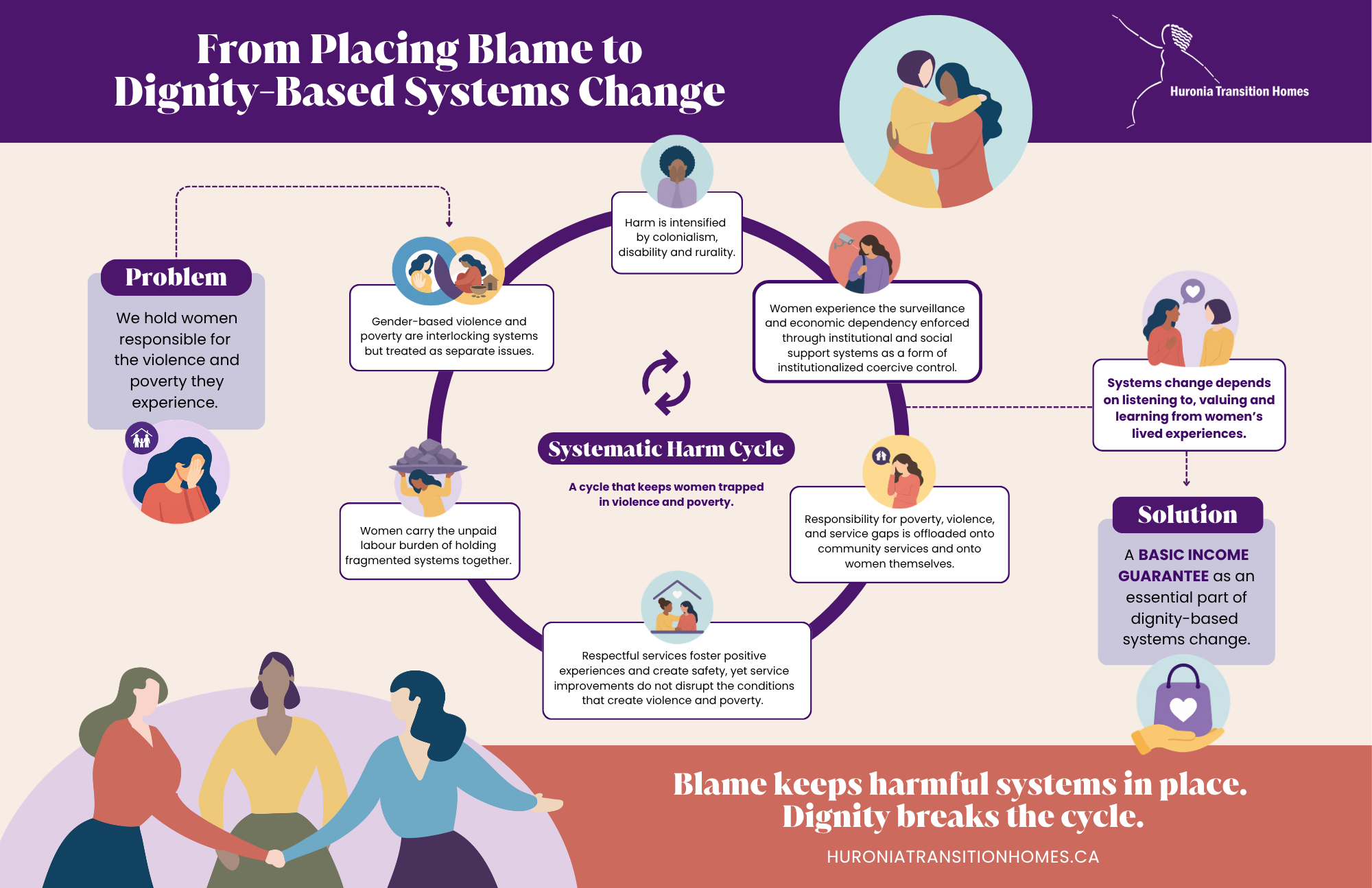
1. Gender-based violence and poverty are interlocking systems not isolated experiences 

2. Institutional and social support systems replicate control, enforcing surveillance and economic dependency

3. Indigenous women’s access to systems of support are impacted by colonialism 

4. Women carry a gendered burden of system navigation

5. Respectful services foster positive experiences

6. Systems change depends on listening to, valuing, and learning from women’s lived experiences

Key Findings

  • Poverty is gendered, and violence operates as an economic system that erodes autonomy and security
  • Institutional responses often replicate coercive control through surveillance, punitive rules, and inadequate supports
  • Indigenous women face compounded harm due to colonial policies and systemic racism
  • Women carry a heavy, unpaid burden navigating fragmented systems, worsened by transportation and housing insecurity
  • Respectful, trauma-informed, low-barrier services improve safety and outcomes
  • Systems change requires centering women’s lived experience and meeting basic needs

Our Recommendations

  1. Adopt and implement a Basic Income Guarantee as a core anti-violence and anti-poverty measure
  2. Centre women’s lived experience in system design to advance cross-sector substantive equality
  3. Move from crisis response to prevention, integrating solutions to poverty reduction and violence prevention
  4. Strengthen access to safe, affordable, accessible, and supportive housing
  5. Fund feminist, trauma-informed, low-barrier services led by Violence Against Women and Indigenous Women’s organizations
  6. Reduce the gendered burden of system navigation 
  7. Explicitly recognize and respond to economic abuse to expand eligibility for housing and social support systems
  8. Redesign income supports to promote autonomy and reduce conditionality
  9. Expand eligibility for Disability Tax Credit and provide adequate Canada Disability Benefit
  10. Fund Indigenous culturally grounded supports and remove colonial barriers, including removal of sex-based discrimination from the Indian Act

Stewardship Council Info

Strategic guidance for the Thrive project is provided through a multi-sector Stewardship Council that integrates academic, Indigenous, public health, and anti-violence perspectives, strengthening both community accountability and policy relevance. The Stewardship Council includes:

  • Janet Mosher, Associate Professor, York University
  • Christine Bushey, Manager, Chronic Disease Prevention Program; 
  • Simcoe County District Health Unit
  • Meaghan Chambers, Executive Director, The Elizabeth Fry Society of Simcoe Muskoka 
  • Lisa Moreau, Waabano Kwe Coordinator; Georgian Bay Native Women’s Association 
  • Lauren Foote, Community Health and Wellbeing Coordinator; Chigamik Community Health Centre