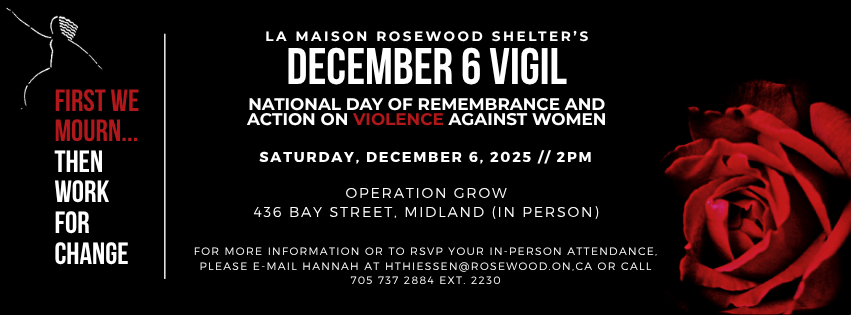
December 6th, 2025: Gallery Walk-through Activity

On December 6th, 2025, the National Day of Remembrance and Action on Violence Against Women, our community gathered to honour, mourn and remember the lives of the women and children across Ontario who have lost their lives this year due to the ongoing epidemic of gender-based violence.

After the vigil, we asked 6 questions of those who attended regarding how we end all forms of violence against all women. Thank you to all who showed up, participated, and added their voice to this movement. It takes an entire community to create change.

These were the responses from our community:

What attitudes in our communities needs to change to end violence against women and gender-diverse people?  

You told us that our community needs to change attitudes that… 

dismiss, belittle or blame those who have experienced violence 

disguise oppression and abuse as “traditional values” 

enable feelings of entitlement or superiority amongst men 

enable feelings of complacency amongst men towards gender justice.  

suggest that women need to be silenced or controlled by their partners 

don’t centre the needs of women and children 

suggest that gender-based violence is a “women’s issue” 

dismiss the scale and severity of gender-based violence in our community 

What role do governments play in ending violence against women?  

You told us that our municipalities play a role by… 

advocating for increased funding and resources 

amplifying the voices of local women’s shelters and sexual assault counselling centres to increase public awareness 

ensuring that residents are aware of their rights, and what supports are available to them before they need them 

advocating for public education in local schools on topics of consent and healthy relationships 

listening to the needs voiced by members of the community 

calling out bad attitudes in council chambers 

create opportunities for honest discussions and gatherings in collaboration with organizations doing gender-based violence work specifically 

making violence against women central to their community health & wellbeing plan in collaboration with organizations doing gender-based violence work specifically. 

advocating for more mental health supports that are free and accessible for all 

advocate for funding for more training for first responders and front-line staff.  

What barriers could be removed to help women and gender-diverse persons experience safety and wellbeing?  

You told us that the barriers that could be removed were… 

a lack of safe, affordable or supportive housing 

a lack of emergency beds for those fleeing abuse 

judgment and blame when women do seek help 

a lack of harm-reduction approaches amongst Violence Against Women organizations 

a lack of medical supports 

alternative options (i.e. restorative or transformative justice), or reform within the legal system 

a lack of women in public office 

a lack of public education around gender-based violence 

a lack of funding 

What role do men play in ending violence against women?  

You told us that we need the men in our community to… 

be an involved community member who actively works towards making change 

understand that power that is built together is far greater than power that is held over others 

model and teach respectful non-coercive and non-violent behaviour to children 

be vulnerable when you are struggling and ask for support 

look for signs of struggle in the men in your life and offer support 

hold one another accountable for harmful behaviour you witness 

learn the differences between “calling out,” “calling in,” and “cancellation,” and what are appropriate situations for each 

educate yourself and your family/friends on topics of consent and coercion from a feminist lens 

imagine a model for masculinity that holds respect for all life at its core 

believe, support and stand with women, children and gender-diverse people if they share with you about a violent or oppressive experience 

spend time listening to the stories of violence or oppression of those in your life or community 

What conditions allow violence against women and gender-diverse persons to exist and thrive?  

You told us that the conditions that allow violence to exist and thrive are… 

a lack of diversity amongst those in power 

the limitations of our current legal system 

a collective silencing around issues of violence and oppression 

systemic forms of oppression that exploit some for the benefit of others (capitalism, hetero-patriarchy, colonialism, white supremacy) 

socioeconomic inequalities 

raising children with sexist or misogynistic values  

perpetuating strict gender roles and stereotypes 

the cyclical nature of abuse (hurt people hurt people) 

the expectations put on survivors within our legal system 

not teaching concepts in schools such as respect and consent 

the silence of men on this issue, or worse, their dismissal  

a lack of resources or beds for those fleeing violence 

What would a community without violence against women and gender-diverse persons look like?  

You told us that a community without violence would look or feel like… 

gathering around arts and storytelling for the purpose of change-making 

heart-warming, loving, happy, safe, clear, open, honest, peaceful, fun, harmonious, welcoming, free, compassionate, equitable 

justice and liberation for all beings, understanding that we are all connected 

reduced fear, anxiety and self-protection measures 

room for everyone to be who they are and do what they want, without harsh judgment 

a communal, honest and non-punitive response to harm caused  

more ability to connect with one another without fear of prejudice  

more ability to express who you truly are without fear of prejudice